NH Tech Solutions Request a walkthrough Contact

For makers of valves, instruments and pumps · their distributors · the plants that use them

Your range, ready to quote. Your signal, ready to read.

Selection tools, configurators and tender bid packages that answer an enquiry the way your best sales engineer would. Monitoring pages that put your measurements in a browser, on a phone or on a wall screen. All under your brand.

Opens an email · or write to roberto.alberio@nhtechsolutions.it · reply within two working days

Built by Roberto Alberio, a sales engineer who has specified flowmeters, transmitters and control valves for 16 years. You talk to the person who builds your tool.

Nameplate · FT-101Fictitious range · Simulated signal

FT-101 · Electromagnetic flowmeter · DN 100

DUTY60 m³/h · 2.12 m/s · 95 °C · 10 bar · hot water

Your logo

Ordering code · from the configurator

DF200–100–P16–F2–S3–A1

  1. 1ModelDF200
  2. 2SizeDN 100
  3. 3RatingPN 16
  4. 4LinerPFA
  5. 5Electrodes316L
  6. 6Output4‑20 mA + pulse

EXCLUDED · Hard rubber liner: process 95 °C, liner limit 80 °C

Signal · on the monitoring page

12.00 mA60.0 m³/h

Normal

Span 4‑20 mA = 0-120 m³/h

Fig. 1 shows a nameplate for a fictitious electromagnetic flowmeter, tag FT-101, DN 100, with ordering code DF200-100-P16-F2-S3-A1 and the key for each segment. A hard rubber liner is excluded because the process runs at 95 °C and the liner limit is 80 °C. Below, a simulated 4-20 mA signal of about 12 mA, 60 cubic metres per hour, is drawn against a high alarm threshold at 16 mA, 90 cubic metres per hour, which sends an email.

Fig. 1 · One instrument, two tools. The configurator writes its ordering code and says why an option is excluded; the monitoring page shows its signal.
Licence
Perpetual, royalty-free
Source code
Full source, handed over at delivery
Price
Fixed, agreed before work starts
Brand
Your logo, colours and domain
First step
A working demo on your range, before any contract
01 · Two lines of workOne method

Two lines of work, built on the same field experience.

Both serve the same world: valves, instruments and pumps, and the people who sell, specify and run them. Pick the door that matches your question.

For makers and distributors of valves, instruments and pumps

Configurators and bid packages

“Can our customers and distributors get the right model, its ordering code and its documents, without waiting for our one expert?”

See the sales tools

For sensor makers, utilities, plants and machine builders

Monitoring pages and screens

“Can the people who need a reading see it on a phone or a wall screen, without a SCADA project?”

See monitoring

02 · Field notes16 years, four patterns

Sixteen years of selling instruments. The same four problems, again and again.

I have specified flowmeters, transmitters and control valves for manufacturers and distributors, working with contractors and end users, from single workshop orders to large projects. These are the patterns I saw from the inside, and what I build instead.

#PatternWhat I sawWhat I build instead
N.01The quote waits for the one person who knows the range.Every non-standard enquiry goes to one or two people. When they are busy or away, the customer waits, or buys elsewhere.I sit with those people and write their rules down, in your product’s language: a tool that knows a Class 300 flange from a PN 40 one. It asks the questions they ask, for every customer and distributor, at any hour.
N.02The in-house configurator in its third year.An internal project starts well, then competes with daily work. Three years on, it still does not quote.A fixed scope sized to finish, and a working demo in your brand before you sign anything.
N.03The tool that left with its vendor.A hosted selection tool goes offline: the vendor is sold, closes, or is hit by a cyber-attack. The rules inside it go too.You receive the source code and the files. The tool runs on your website, your intranet or a laptop, with or without me.
N.04The signal that ends at a terminal block.A transmitter measures all day, but the reading stays on a local display or in a system few people can open.The same 4‑20 mA or Modbus signal travels over 4G or NB‑IoT to a page the right people read on a phone or a wall screen.
03 · Sales toolsSelect · Configure · Bid

The questions your sales engineer asks, built into a tool.

Three tools that carry your sales engineer’s knowledge to the people who need it: your customers’ engineers, your distributors and your own sales team. On your website, at any hour, and every answer traces back to a rule your engineer approved.

  1. 01 · Select

    Select.

    The customer enters the duty: medium, flow, pressure, temperature, connection. The tool ranks your range and explains every exclusion in plain words.

    IN
    duty point
    OUT
    ranked shortlist, reasons
  2. 02 · Configure

    Configure.

    Only combinations your factory can build are offered. The ordering code assembles as options are chosen, with a live datasheet and a draft offer.

    IN
    model + options
    OUT
    ordering code, datasheet PDF, draft offer
  3. 03 · Bid

    Bid.

    The Tender Response Pack reads an RFQ and its specification, recognises 34 requirement types, checks every line against your product library and writes the compliance matrix and the bid package.

    IN
    RFQ + specification
    OUT
    compliance matrix, 12 documents

Most enquiries I answered started from a duty, not a part number. So the tool starts there too.

— R.A.

Tender Response Pack

One RFQ in. Twelve documents out.

Paste a requisition. The engine reads it, lists the requirements it recognises, checks each line against your product library and writes the bid package. Lines outside your range become deviations, stated, not buried. It all runs in the browser: nothing is uploaded.

RFQ · fictitious contractor · Rev. B

4 lines · 22 valves · 21 requirements read · 9 areas

6 deviations · 8 clarifications

  1. TRP-01Cover emailThe covering email: what is attached, what is offered, what deviates.
  2. TRP-02Technical offerScope of supply line by line, with the compliance summary.
  3. TRP-03Commercial offerPrices, delivery, validity and terms, per line.
  4. TRP-04Deviations and clarificationsEvery requirement outside the range, stated with the reason.
  5. TRP-05Datasheets, one per line, with ordering codeOne datasheet per line item, each with its ordering code.
  6. TRP-06Painting cycleSurface preparation and coating system, per the specification.
  7. TRP-07Production scheduleFrom order to dispatch, as a Gantt chart.
  8. TRP-08Inspection and test plan (H/W/R points)Each inspection with its hold, witness or review point.
  9. TRP-09Certificates and documents listWhat is delivered, when, and to which standard.
  10. TRP-10Packing and shippingPreservation, marking and packing.
  11. TRP-11Spare partsRecommended spares, with quantities and prices.
  12. TRP-12Warranty and conditionsWarranty period and the conditions of the offer.

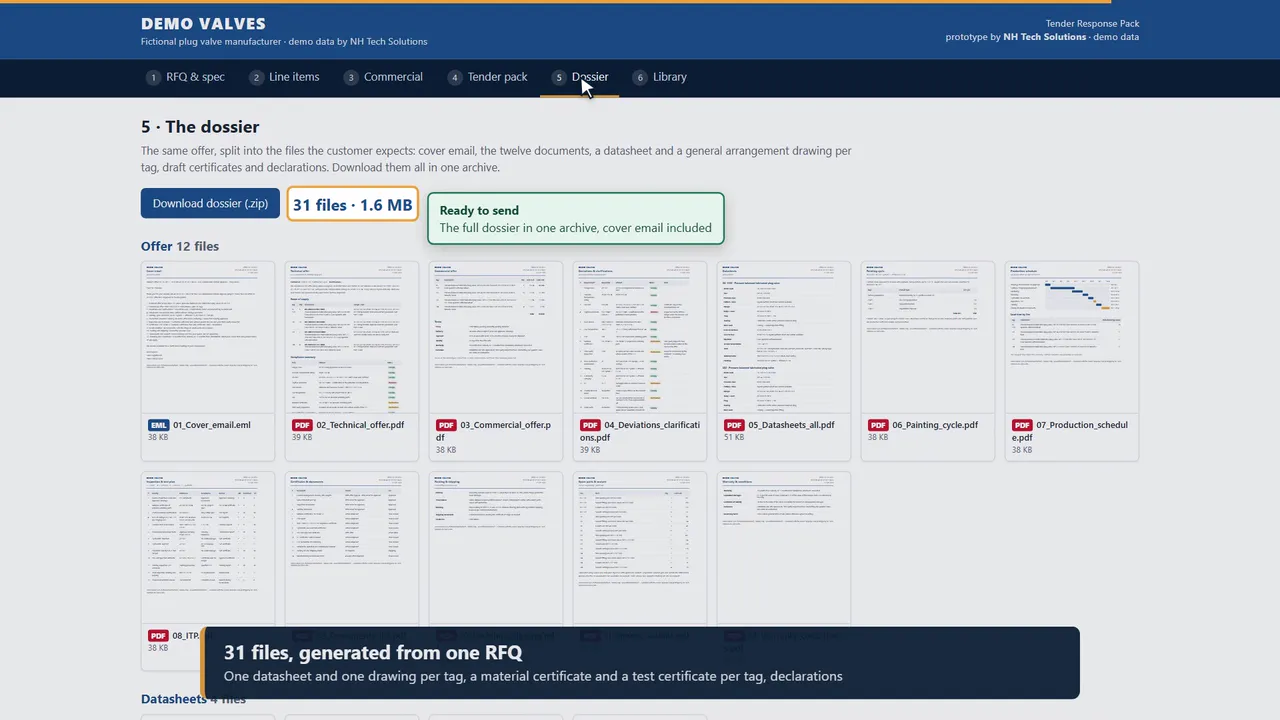
Dossier: these 12 documents + a datasheet and a GA drawing per line + draft certificates = 31 files · 1.6 MB

nhtechsolutions.it/demo/tender-pack.html
  • 34

    requirement types recognised: design code, testing, fire-safe, fugitive emissions, sour service, materials, certificates, painting, documentation.

  • 12

    documents in every bid package; the dossier adds a datasheet and a GA drawing per line.

  • 0

    uploads: the RFQ is read in your browser and never leaves the page.

Fig. 2 · Watch a sample RFQ become a 12‑document bid package (2′28″). Demo Valves is a fictitious plug-valve maker; every figure is invented.

Video summary: a sample RFQ is pasted and read; requirements are listed by area; each line is checked against the product library; deviations and clarifications are written; the twelve documents are generated and saved as one dossier.

Requirement types the engine already recognises include:

  • API 6D
  • API 6A
  • ASME B16.34
  • API 607 / API 6FA fire-safe
  • ISO 15848-1 fugitive emissions
  • NACE MR0175 / ISO 15156
  • EN 10204 3.1 / 3.2
  • NORSOK M-501
  • ISO 12944
  • PED
  • ATEX
  • SIL

The demo uses a plug-valve range. With your product library loaded, the engine checks each line against your own valve types, sizes, classes and materials. Your own standards and house rules are added during the study.

Same engine, two other valve families

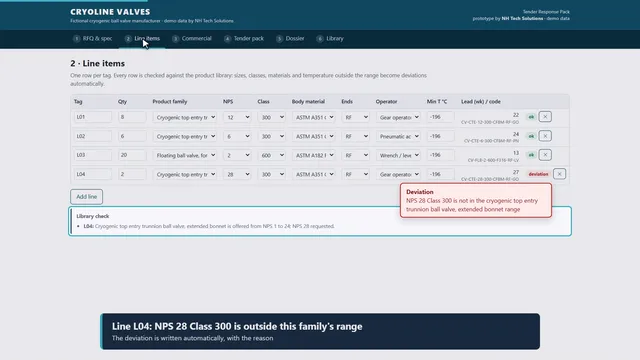
  • LNG terminal · −196 °C

    Cryogenic ball valves

    Extended bonnets, cryogenic type test, fire-safe, SIL 2. A 28″ top-entry line is out of range and moves to side entry, as a stated deviation.

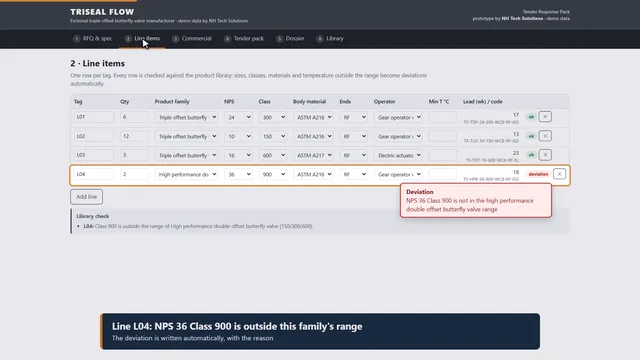
  • Refinery revamp · API 609 Cat. B

    Triple-offset butterfly valves

    Zero leakage, a 540 °C line, SIL 2 actuators. A 36″ Class 900 line moves to the triple-offset family.

Cryoline Valves and TriSeal Flow are fictitious manufacturers. Videos play from YouTube in privacy-enhanced mode and load only when you press play.

See a tool on a range like yours, in 30 minutes.

04 · MonitoringMeasure · Send · Show · Alert

One signal. Three screens. Your name on all of them.

A transmitter’s 4‑20 mA signal often ends at a local display, or in a control system only a few people can open. These pages take it where people do look: a web portal, a phone, a wall screen in the office. With history, thresholds and email alarms. Under your brand if you make the sensor; under your plant’s name if you run it.

12.00 mA → 60.0 m³/h
Brand

Email alarm

None sent yet. An email goes out when the signal stays above 16.0 mA for 2 s.

Three frames, a web browser at monitor.your-brand.example, a phone and a 50-inch office wall screen, each show tag FT-101 inlet flow at about 60 cubic metres per hour, 12 milliamps, with a 60-second trend, a dashed high-alarm line at 90 cubic metres per hour and a status of normal.

INPUT4‑20 mA / Modbus RS485 · SCALING4 mA = 0, 20 mA = 120 m³/h · ALARMabove 16.0 mA, by email · MODEread-only · DATAsimulated

Signal faultBelow 3.6 mA or from 21 mA upwards the page reports a signal fault, not a flow value; between 3.6 and 4 mA it shows zero, never a negative flow (NAMUR NE 43).

Fig. 3 · The same simulated reading as Fig. 1, on a web portal, a phone and a 50-inch office screen. In a call, a 4‑20 mA generator stands in for your transmitter. Brands and domains are fictitious. Light and dark included.
  1. 1 · Measure
    Your transmitter

    Measure. Your transmitter, already on site or new.

  2. 2 · Send
    4G gateway · NB‑IoT node

    Send. A 4G gateway reads the 4‑20 mA loop or the transmitter’s Modbus RS485 output, or a compact NB‑IoT node does it on its own. Independent of your company network.

  3. 3 · Show
    Monitoring pageBrowserPhoneWall

    Show. Web page, phone, wall screen: live values, history, reports.

  4. 4 · Alert
    Email alarm

    Alert. An email when a value crosses its threshold, and another when it returns.

WHAT I SUPPLYALREADY YOURSSIGNAL PATH

READ ONLY · NO WRITE-BACK · NOT A SAFETY SYSTEM

Fig. 4 · Signal chain. Solid boxes: what I supply. Dashed boxes: what is already yours.

Three people, three questions.

A screen that answers one question for one person gets looked at. A screen with forty numbers does not.

— R.A.

Water utility · Consortium

Is there a leak tonight?

Seven days of district inflow. The night minimum of the last three nights sits above the dashed baseline. NIGHT BASELINE −7 DAYSNOW

● Night minimum above the baseline, three nights

The night minimum has stayed above its baseline for three nights. Someone should walk the district tomorrow morning.

Measurement, transmission and the page: from a template, as a custom portal, or rented per measuring point.

Machine builder · Retrofit

Is this valve getting slower?

Valve closing time over three weeks, rising from 420 to 610 milliseconds and entering the band above 560 milliseconds. BAND 560 ms 420 ms 610 ms −3 WEEKSTODAY

Closing time has crept from 420 to 610 ms in three weeks and has entered the band you set. Plan an inspection before it stops the line.

A tablet beside the machine or a screen in the production office. Runs on its own network. Visibility, not prediction.

Sensor maker · Distributor

Is my customer’s sensor healthy?

Six meters since midnight. Meter 07 drops to an empty-pipe state at 06:10 and stays there. M04M05M06M07M08M09 00:0006:00NOW

● M07 · empty pipe since 06:10

Meter 07 has reported an empty pipe since 06:10. You know before your customer calls.

Your sensor’s signal, on your portal, under your brand.

Demo scenarios, simulated data.

In the call, a 4‑20 mA generator moves the chart and sends the alarm email.

05 · MethodFrom your catalogue to a working tool

You send the catalogue. You get back a working demo.

Most of a manufacturer’s selection knowledge sits with one or two people. My job is to get it out of their heads, structure it, and publish it as a tool that asks the questions they ask. Before you sign anything, you see your own range working, with your logo; for monitoring, your own signal on a page with your name.

Steps 0–3 cost you nothing but two working sessions with your engineer.

  1. 0

    Call

    Day 0

    Thirty minutes. You describe the range or the plant, and the problem; I show a tool for a case like yours.

  2. 1

    Study

    After the call

    You send the catalogue, price list and ordering-code key. I map models, options, rules and exceptions. For monitoring: what is measured, where, with which signal, and who needs to see it.

  3. 2

    Know-how sessions

    Two sessions

    With your sales engineer: the questions they ask, the combinations they refuse, the documents they send. They approve every rule.

  4. 3

    Demo in your brand

    Before any contract

    A working page and a short video with your logo, your range and your codes. You judge a result, not a proposal.

  5. 4

    Fixed price, then build

    Date in the offer

    Scope, price and delivery date agreed in writing before work starts.

  6. 5

    Pilot and handover

    At delivery

    Your team uses it on real enquiries and I adjust it. Then you receive the source code, deployed where you want it. Annual care is optional.

What you receive

LicencePerpetual and royalty-free, with the full source code: use it, change it, deploy it, also with another developer. No per-user fees.
DeliverySales tools: static HTML, CSS and JavaScript. No database, no user accounts, no server to maintain, and no subscription needed to keep them working.
Runs onYour website, your intranet, a laptop at a trade fair, even offline.
Your dataDuty data, configurations, prices and RFQs are processed in the user’s browser. Nothing reaches NH Tech Solutions. An enquiry reaches you only when the user sends it, by email or through your own website form, with the ordering code already filled in.
MonitoringBuilt at a fixed price. Hosting, SIM data or per-point rental, where you choose them, are recurring costs stated in the offer. Readings are stored where you decide: hosted for you, with the provider and location named in the offer, or on your own server or PC. Nothing is written back to the plant.
Range changesRules kept in plain files; updated under optional annual care, or by your own team.
SupportThe engineer who built it. Reply within two working days.

Request a 30-minute walkthrough

06 · Pilot programme 2026–27Places open

A small number of pilot places, in four segments.

NH Tech Solutions is a young practice. From autumn 2026 I am building tools with a small number of pilot companies, a few at a time. Pilot companies contribute to the development cost and get a tool built around their range, with more of my time than any later client will get.

Open in four segments

  • Valves
  • Flow and level instruments, and their distributors
  • Pumps
  • Monitoring: sensor makers, utilities, machine builders

What a pilot gets

  • A study of your range
  • A demo in your brand before you commit
  • The tool built and adjusted with your team
  • Source code and handover
  • A say in what the tools do next

What I ask in return

  • A contribution to development, agreed in writing before work starts; for a pilot company it is the fixed price
  • Two sessions with the person who knows your range
  • Honest feedback
  • Permission to describe the project without your name, and by name only if you agree
Ask about a pilot place

STATUS UPDATED BY HAND · LAST UPDATE OCTOBER 2026

07 · Who builds itFounder-led

I have sat where your sales engineer sits.

I’m Roberto Alberio. For sixteen years I have sold and specified flowmeters, transmitters and control valves for manufacturers and distributors, working with EPC contractors and end users, from single workshop orders to large projects. I started building software because the same questions kept arriving, and the answers kept waiting for one person. NH Tech Solutions is where that experience becomes software. I work in Italian, English and French.

Roberto Alberio
ROBERTO ALBERIO
SARONNO (VA), ITALY

Built so far

#SECTORWHAT WAS BUILT
01Flow instrumentsWhite-label flowmeter configurators: selection, ordering code, datasheet
02Instrument distributionPrice and quote portal for one product line
03Additive manufacturingDocumentation and quote engine, plus website
04Wine exportExport back-office
05ValvesTender Response Pack enginePublic demo ↗ (opens in a new tab)

Client names are shared only with their permission.

08 · QuestionsBefore the first call

Questions buyers ask before they write.

01How long does it take?

A first demo on your own range, in your brand: two to five working days from your catalogue. A configurator or a bid-package tool follows a few working sessions and a signed NDA, and its delivery date is written into the fixed-price offer. Speed is not what I sell, though. What I sell is a tool that gets your products right, built by someone from the trade, at a modest fixed price.

02What do you need from us?

Your catalogue and datasheets, the price list, the ordering-code key, and two sessions with the person who knows the range best. For a bid package, one real RFQ you can share under NDA. For monitoring: what you measure, where, and who should see it.

03Does it touch our IT or our ERP?

Not unless you want it to. The tools are static files on your website or intranet. A live price list or an ERP or CRM connection is a separate, optional step.

04Who owns the code?

You receive the complete source code with a perpetual, royalty-free licence to use, change and deploy it, also with another developer. Your rules, data, texts and branding are yours.

05What happens if NH Tech Solutions stops trading?

You already have everything: the files, the source code and the rules, documented. Any web developer can host and change them. That is the point of building it this way.

06Where does our data go?

For the sales tools: duty data, configurations and RFQs are processed in the user’s browser and are not sent to me. The enquiry goes to you only when the user sends it. For monitoring, readings are stored so the page can show history, on the server you choose, and nothing is written back to your plant. Your rules, prices and RFQs serve your tool only.

07Why not build it in-house, or with an AI tool?

You can. The hard part is not the form; it is the rules: which model fits which duty, which combinations your factory builds, what a compliant bid has to contain. These tools are built from rules your own engineer approves, and every answer can be traced back to one of them.

08Are the public demos built on a real manufacturer’s range?

No. The public demos run on fictitious ranges and simulated data. Your range is never shown to other prospects.

09What does it cost?

A fixed price, agreed after you have seen the demo in your brand and before work starts. It is sized so that the owner can approve it without a procurement project: no per-user licences, no subscription to keep the tool running. Annual care is optional.

10What are the monitoring pages not?

Not a control system, not a safety system and not a SCADA replacement. They show readings, trends and alarms, and never write back to the plant.

09 · ContactSaronno (VA), Italy

Start with one range, one RFQ or one signal.

In 30 minutes I’ll show you a working tool for a case like yours and tell you what a fixed-price first step would include.

Request a 30-minute walkthrough

I reply within two working days, in Italian, English or French, usually proposing two times for a call.